The best camera for content creators depends on what you film. Talking head videos and vlogs suit a compact vlog camera with a flip screen. Walking shots suit a pocket gimbal, and a growing channel that wants better lenses suits an APS-C mirrorless body.
An existing smartphone is already more advanced than several cheap cameras, while higher tiers of cameras are nothing but showing how they compare to what's in your smartphone: bigger sensor, microphone input, recording time, or just the camera.
Before You Buy: 4 Questions That Pick the Right Camera
-
What do you film most? Talking head, vlog, short form or action. Each one points to a different tier below.
-
What would a camera add over your phone? If the answer is only "4K", your phone may already do it. Upgrade for a bigger sensor, interchangeable lenses, a mic input or longer recording.
-
Do you need a mic input? Interviews and talking head videos need one. Skip any camera without it if audio matters.
-
How long are your takes? Streams, podcasts and long tutorials hit recording limits and heat first, so check those numbers before you pay.
Quick Picks by Budget

|
Tier
|
Camera
|
Best for
|
Price
|
|
Under $200
|
Digiera 4K Digital Camera
|
Kids and first time creators
|
$26.24
|
|
Digiera W100 5K Vlogging Camera
|
Beginner vlogs and a second angle
|
$62.99
|
|
|
$200 to $800
|
Canon PowerShot V10
|
Talking head and travel vlogs
|
About $399
|
|
$200 to $800
|
Sony ZV-1F
|
Selfie vlogs with a wide lens
|
About $500 to $600
|
|
$200 to $800
|
Canon EOS R50 with kit lens
|
A first interchangeable lens camera
|
About $680 to $780
|
|
Above $800
|
Sony ZV-E10 II
|
Growing YouTube channels
|
About $1,100 to $1,300
|
|
Above $800
|
Fujifilm X-S20
|
Hybrid photo and video creators
|
About $1,300 body
|
|
Action and pocket
|
DJI Osmo Pocket 3
|
Walking vlogs and travel
|
About $439 to $519
|
|
Action and pocket
|
GoPro HERO13 Black
|
Sports, POV and rough conditions
|
About $400 to $620 by kit
|
Best Budget Cameras Under $200
These cameras will act as starter cameras, not as substitutes for the other cameras mentioned below. They have smaller sensors than the 1-inch and APS-C cameras above, so their footage can look soft in dark rooms, audio recording is basic, and they don't support lens changes.
Digiera 4K Digital Camera
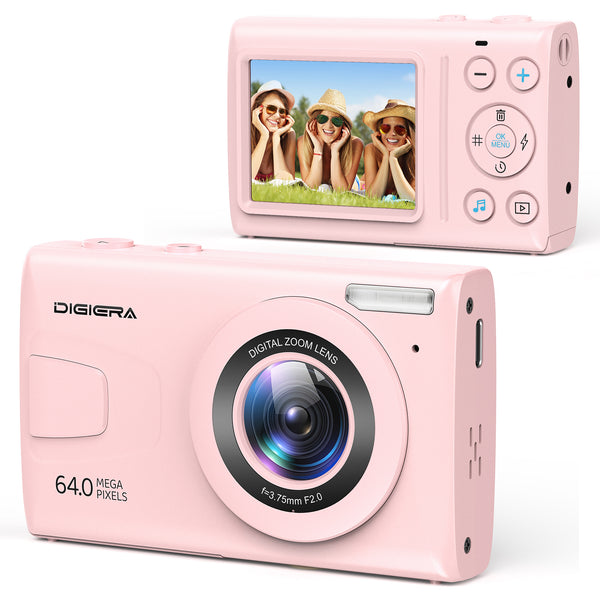
The Digiera 4K Digital Camera records 4K UHD video and 64MP photos, with face tracking autofocus, 18x digital zoom and a built in flash. It is available in pink or black color and coming at a price of $26.24 at the moment. It is ideal for children, teenagers, and those who wish to see if they like shooting videos before investing more money.

Since the digital zoom function crops the images, the images get blurry when one uses it. Its screen is facing backwards hence not suitable for self-filming.
Digiera W100 5K Vlogging Camera
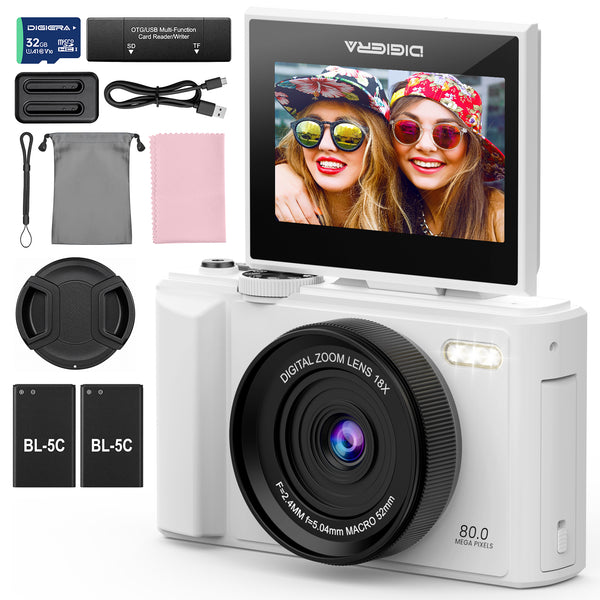
The Digiera W100 5K Vlogging Camera adds autofocus and a screen that flips 180 degrees, so you can frame yourself while talking to the lens. It shoots 5K video and 80MP photos, comes in black, white and pink, and costs $62.99. The kit adds a 32GB card, a card reader and two batteries, so it's ready to film out of the box.

It works as a beginner vlog camera or a second angle next to a phone. Not sure the extra resolution matters? Our guide on whether 5K matters over 4K for vlogging breaks it down.
Best Vlog Cameras From $200 to $800
Canon PowerShot V10
A pocket vlog camera with a 1 inch sensor, 4K at up to 30 fps and a built in stand. About $399.
-
Best for: Talking head clips and travel vlogs.
-
Autofocus and screen: Contrast detect autofocus with no manual focus. The 2 inch screen tilts up 180 degrees but doesn't swing to the side.
-
Audio: A 3.5mm mic input, rare at this size.
-
Recording limits and heat: Canon limits each clip to 1 hour. Canon also recommends a V30 or faster card for video.
Sony ZV-1F
A compact with a 1 inch sensor, a fixed 20mm wide lens and 4K at up to 30 fps. About $500 to $600.
-
Best for: Selfie vlogs where you hold the camera at arm's length.
-
Autofocus and screen: Contrast detect autofocus with a product showcase mode. The 3 inch screen flips fully to the side.
-
Audio: A mic input, but no headphone jack.
-
Recording limits and heat: The wide fixed lens can't zoom, and long 4K takes warm the body, so film in shorter segments on hot days.
Canon EOS R50 with kit lens
An APS-C mirrorless camera that records 4K at up to 30 fps, oversampled from 6K with no crop. About $680 to $780 with the kit lens.
-
Best for: A first camera with interchangeable lenses.
-
Autofocus and screen: Dual Pixel CMOS AF II with subject tracking, plus a 3 inch vari angle touchscreen.
-
Audio: A 3.5mm mic input.
-
Recording limits and heat: Canon states continuous recording capacity of up to 1 hour or 15 minutes at 120 fps.
Best Mirrorless Cameras Above $800
Sony ZV-E10 II
A 26MP APS-C body built for video, with 4K at up to 60 fps in 10 bit. About $1,100 to $1,300 depending on kit.
-
Best for: Growing YouTube channels that want lens options.
-
Autofocus and screen: Fast phase detect autofocus and a 3 inch articulating touchscreen that works for vertical video.
-
Audio: Mic input and headphone output, plus a three capsule directional mic.
-
Recording limits and heat: In Videomaker's test it overheated every 20 to 25 minutes at 4K60 200 Mbps, but not at 50 Mbps. Use lower bitrates for long talks.
Fujifilm X-S20
A 26MP APS-C hybrid that shoots 6.2K at 30 fps and 4K at up to 60 fps, with a vlog mode. About $1,300 for the body.
-
Best for: Creators who shoot photos and video in equal measure.
-
Autofocus and screen: Subject detect autofocus and a fully articulating 3 inch touchscreen.
-
Audio: Mic and headphone jacks for monitoring audio.
-
Recording limits and heat: Fujifilm's optional FAN-001 cooling fan more than doubles continuous recording time.
Best Action and Pocket Gimbal Cameras
DJI Osmo Pocket 3
A pocket gimbal camera with a 1 inch sensor and a 2 inch OLED screen that rotates for vertical video. About $439 to $519 in the US.
-
Best for: Walking vlogs, travel and solo creators.
-
Autofocus and screen: Face tracking keeps you centered while the 3 axis gimbal smooths each step.
-
Audio: A built in three mic array, and it pairs directly with a DJI Mic 2 for two person audio.
-
Recording limits and heat: Up to 166 minutes of battery life. The newer Osmo Pocket 4 isn't sold in the US, so the Pocket 3 is still the pick there.
GoPro HERO13 Black
A waterproof action camera that shoots 5.3K at 60 fps, with a front screen for framing. About $400, or around $620 for the Creator Edition.
-
Best for: Sports, POV and filming in rain, snow or water.
-
Autofocus and screen: Wide fixed focus lenses and strong stabilization, with a front screen for selfies.
-
Audio: Built in mics with a voice setting. Add the Media Mod that comes with the Creator Edition to use an external microphone.
-
Recording limits and heat: Approximately 1.5 hours of non-stop 4K30 recording in the Enduro battery mode.
How Fast a Memory Card Needs to Be for 4K
The V number on an SD card is its minimum write speed in megabytes per second, under the SD Association's Video Speed Class. A V30 card holds at least 30MB/s, which covers most 4K recording. The high bitrate modes, such as 200Mbps for 4K60 on ZV-E10 II, will require a V60 or V90 card.
Portable gimbals and action cameras, like Osmo Pocket 3 and HERO13, will require microSD cards, so make sure you have both matching in terms of class and format. Our guide to SD card speed classes explained explains every rating on the label. Long 4K shoots fill cards fast, so it helps to plan for offloading too, and this guide to picking a portable SSD for video editing covers the drives that keep up.
FAQs
What camera do most content creators use?
There's no single camera. Vloggers often use compacts like the Sony ZV-1F or Canon PowerShot V10, walking and travel creators use pocket gimbals, and growing channels move to APS-C mirrorless bodies like the Sony ZV-E10 II.
Do I need a camera to be a content creator?
No. Many creators start on a phone. A dedicated camera helps when you need a bigger sensor, a mic input, interchangeable lenses or longer takes than your phone handles well.
What is the best budget vlogging camera?
Under $200, the Digiera W100 is a solid starter with autofocus and a flip screen for $62.99. If you can spend around $400, the Canon PowerShot V10 adds a 1 inch sensor and a mic input.
Is a flip screen important for content creators?
Yes, for anyone filming themselves. A screen that faces you shows framing and focus while you talk, which saves retakes. Side flipping screens also leave room for a mic on top.